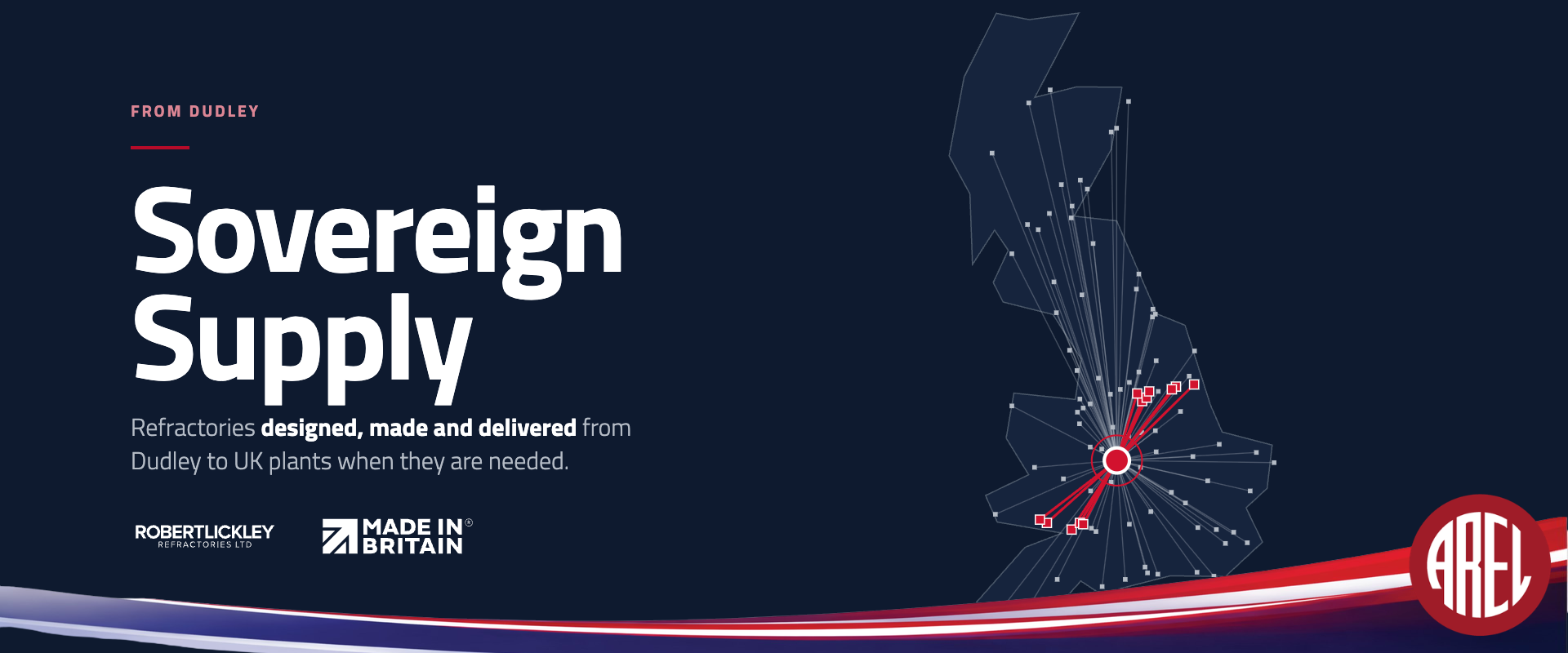

Refractories are a national security issue. They should be treated like one.
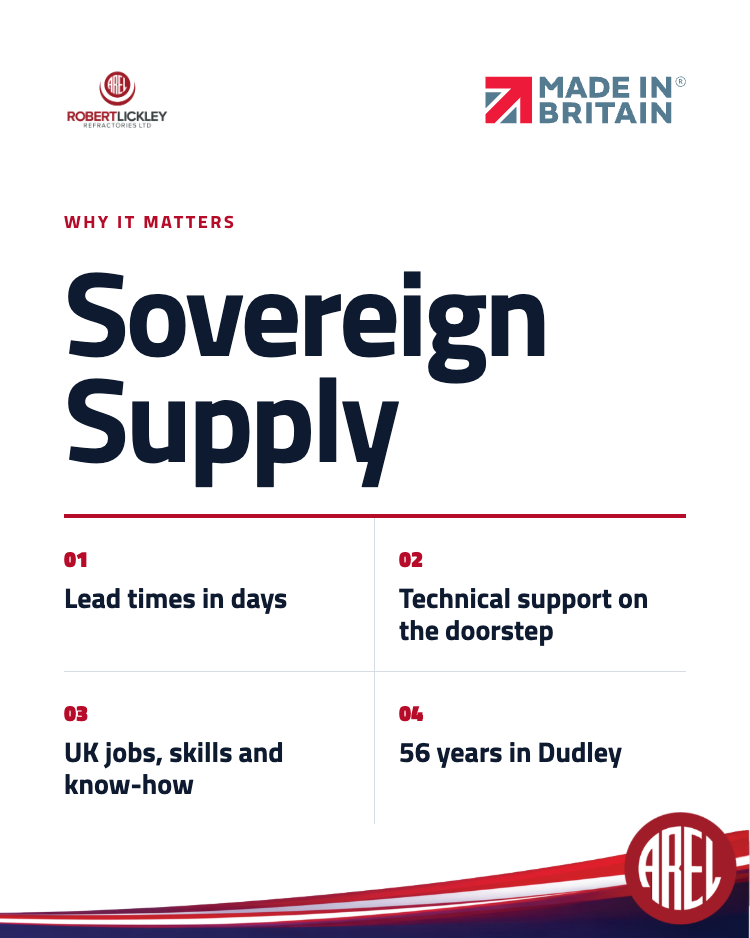
Every tonne of steel, glass, cement, aluminium and cast metal made in this country passes through a refractory lining. If the lining fails or the material doesn’t arrive, the plant stops. Most people outside a maintenance team never think about that, and for a long time, neither did UK industrial policy.
That’s finally changing. The Steel Strategy published in March sets a target for UK mills to supply 40 to 50% of the country’s steel, up from around 30% [1][2]. It cut import quotas by 60% from July, with a 50% tariff on anything above them [1]. Reindustrialisation is now on every party’s agenda, and sovereign capability in steel, defence and energy has moved from a slogan to stated government policy. Made in Britain has never had a louder voice.
All of that is welcome. But you can’t have sovereign steel without sovereign refractories.
Where refractories live
Blast furnaces and the electric arc furnaces replacing them. Ladles, tundishes and continuous casters. Reheat furnaces and forges, including the ones making castings and forgings for defence. Glass tanks, cement and lime kilns, aluminium melting and holding furnaces, foundry cupolas, energy-from-waste plants, incinerators, petrochemical crackers and power station boilers.
Take refractories away and none of those run. That’s the security argument in one paragraph.
This isn’t about bashing imports
Overseas suppliers have a place, and raw material we use come from abroad. The problem is dependence. A country that can’t make its own linings is relying on someone else’s power prices, shipping lanes and export priorities to keep its furnaces lit. The last few years have shown how fast that can go wrong.
How few of us are left
Twenty-five years ago the UK still had a real refractory industry. In its prime, GR-Stein alone ran 13 plants across the country making more than 300 products, and employed over 2,000 people in its Scottish works alone [3]. The Manuel Works near Linlithgow, once among the largest plants of its kind, closed at the end of 2001 and production moved to England and Poland [4]. The relocation was decided as part of a group-wide restructuring by its multinational owner [5]. Vesuvius shut its Newmilns factory in Ayrshire in 2009 with the loss of 180 jobs [6]. In Sheffield’s Loxley Valley, home to the trade for over a century, the fireclay works closed in the early 1990s [7].
Research went the same way. The UK once had its own British Refractories Research Association, set up in 1920. In 1948 it was merged into a general ceramics research body, which today operates as a commercial testing company [8]. The big groups now run their research centres abroad: the largest UK-listed refractory company has its advanced refractories R&D centre in India and its foundry R&D centre in the Netherlands [9].
Each closure followed the same pattern. The work was moved, the skilled people were made redundant or redeployed overseas, and the knowledge left with them.
Today you can count the UK-owned, UK-only refractory manufacturers on one hand. Much of what’s left belongs to groups headquartered overseas, making decisions on global capacity and shareholder return. Consolidation is still going on, and each round puts more of the UK’s capacity under overseas control.
When a site is closed in a group review, those skills don’t come back.
Skills are the real asset
Refractory knowledge lives in people: mixers, kiln and press operators, lab technicians, installers, and engineers who know how a tundish actually wears over a sequence. Most of them learnt it on the job from someone who’d done it for thirty years. For generations the big steel and refractory employers trained apprentices and the whole sector recruited from that pool [10]. Most of that training has gone.
If the UK is serious about EAF steelmaking, hydrogen and lower-carbon kilns, it will need new linings designed and installed by people who understand both the chemistry and the plant. Those people have to be trained here, now. That’s what we invest in.
Fiercely independent
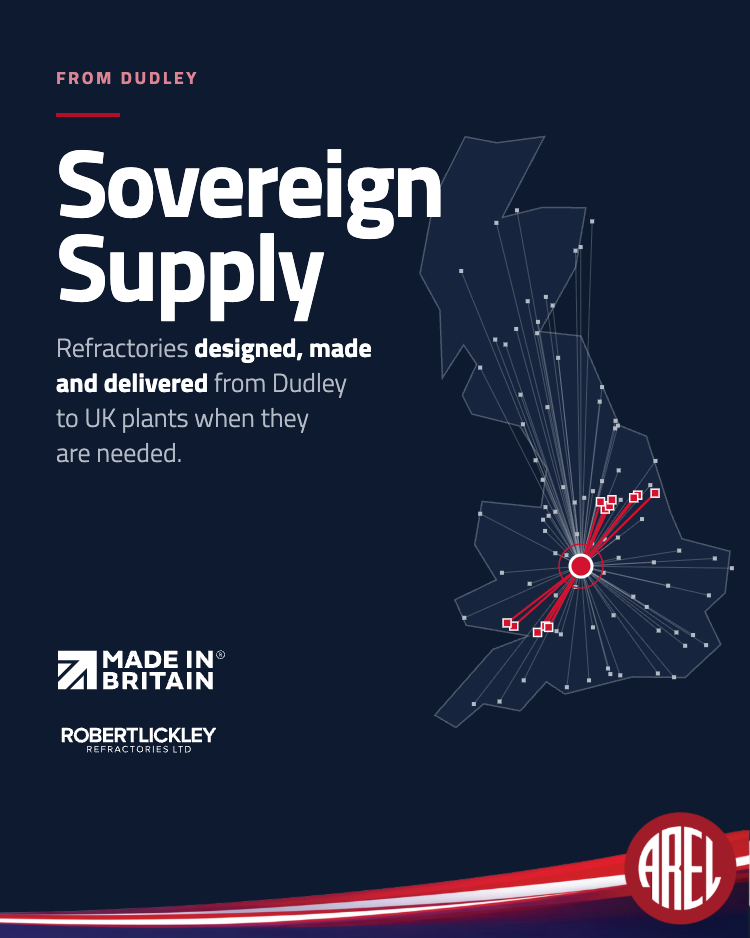
RLR has made refractories in Dudley for 56 years. We are independently owned and answer to no parent group. Every decision about what we make, who we train and where we invest is taken on site.
We’ve stayed with UK steel through the hard years. By the early 2000s we were one of only two approved suppliers on the Corus National Monolithic Contract, and we stayed with Port Talbot through the loss of the Llanwern work. We’re the only UK producer of tundish sacrificial linings. Our lab, built with support from Dudley Council and the UK Government, lets us test and solve problems here rather than send samples abroad. We hold ISO 9001, 14001 and 45001, which puts us in a very small group of UK refractory makers.
We batch to order, so you get material made for your application and our people on site when you need them.
If reindustrialisation is going to mean anything, the supply chain under the steel has to be British too. If you’re reviewing where your refractories come from, or you want a UK second source, talk to us. We’ll come to the plant, look at the application and tell you straight what we can do.
References
[1] UK Parliament, written statement on the UK Steel Strategy, 19 March 2026. https://questions-statements.parliament.uk/written-statements/1892813
[2] Eurometal, “UK announces new Steel Strategy”, March 2026. https://eurometal.net/uk-announces-new-steel-strategy-welcomed-as-game-changer-by-industry-body/
[3] Scottish Brick History, “General Refractories Limited, Sheffield” (GR-Stein company brochure). https://www.scottishbrickhistory.co.uk/general-refractories-limited-sheffield-england/
[4] Falkirk Council Collections, “GR-Stein Refractories Ltd”. https://collections.falkirk.gov.uk/persons/550
[5] British Glass, “Vesuvius to close Manuel Refractories”. https://britglass.org.uk/knowledge-base/digital-library-and-information-services/vesuvius-close-manuel-refractories
[6] Scottish Brick History, “Vesuvius Crucible Works, Newmilns”. https://scottishbrickhistory.co.uk/vesuvius-crucible-works-brown-road-newmilns-east-ayrshire
[7] Subterranea Britannica, “Loxley brickworks”. https://www.subbrit.org.uk/sites/loxley-brickworks/
[8] Lucideon, “Our history”. https://www.lucideon.com/our-company/history
[9] Vesuvius plc, “About us – history”. https://vesuvius.com/en/about-us/history.html
[10] Yorkshire Post, Kevin Parkin, “We’ve heard it all before about reindustrialising Britain”, 2026. https://www.yorkshirepost.co.uk/news/opinion/columnists/weve-heard-it-all-before-about-reindustrialising-britain-kevin-parkin-8788370