

TundRA Flow
See how steel moves through your tundish before anything is built.
Every tundish has a flow you cannot see: where the stream lands, which corners sit still, how long the steel stays. TundRA Flow shows it, so the furniture we fit is the furniture the numbers support.
Flow simulation of your tundish and its furniture, built from your drawings, run on our own machines and explained in plain English.
Watch the steel, not a sketch.
A two-second pulse of dye goes in through the ladle shroud, and TundRA Flow follows it through every part of the tundish until it leaves at the strands. You see where the stream lands, how the weir and dam turn it, which corners it never reaches, and how long the steel stays.
The same model gives the numbers behind the picture: when the first steel reaches the strand, how much of the tundish works as plug flow, and how much is dead volume.
From your drawing to a full report.
Nine studies, one model of your tundish.
Flow and residence time
A dye pulse followed from the ladle shroud to the strands: first arrival, mean residence time, plug flow and dead volume.Heat and buoyancy
The same flow with heat switched on: how the hotter ladle stream rises and where the tundish runs cold.Options side by side
TekBox, dam and weir designs run on the same tundish under the same conditions, ranked like for like.Inclusion float-out
Inclusions of each size tracked through the tundish: how many float out to the slag and how many reach the strand.Where slag is at risk
Where the steel under the cover moves fast enough to tear slag into the stream, in steady casting and through a ladle change.The level drops and recovers
The tundish through a ladle change: the falling level, the opening slag cover and the stream when the new ladle opens.The first ladle into an empty tundish
The splash on the TekBox, the steel reaching each strand and, with a preheated lining, the temperature it arrives at.Draining the tundish
At the end of a sequence: how low the level can go before a vortex over the outlet pulls slag into the strand, and the steel left at that point.The vortex in the ladle
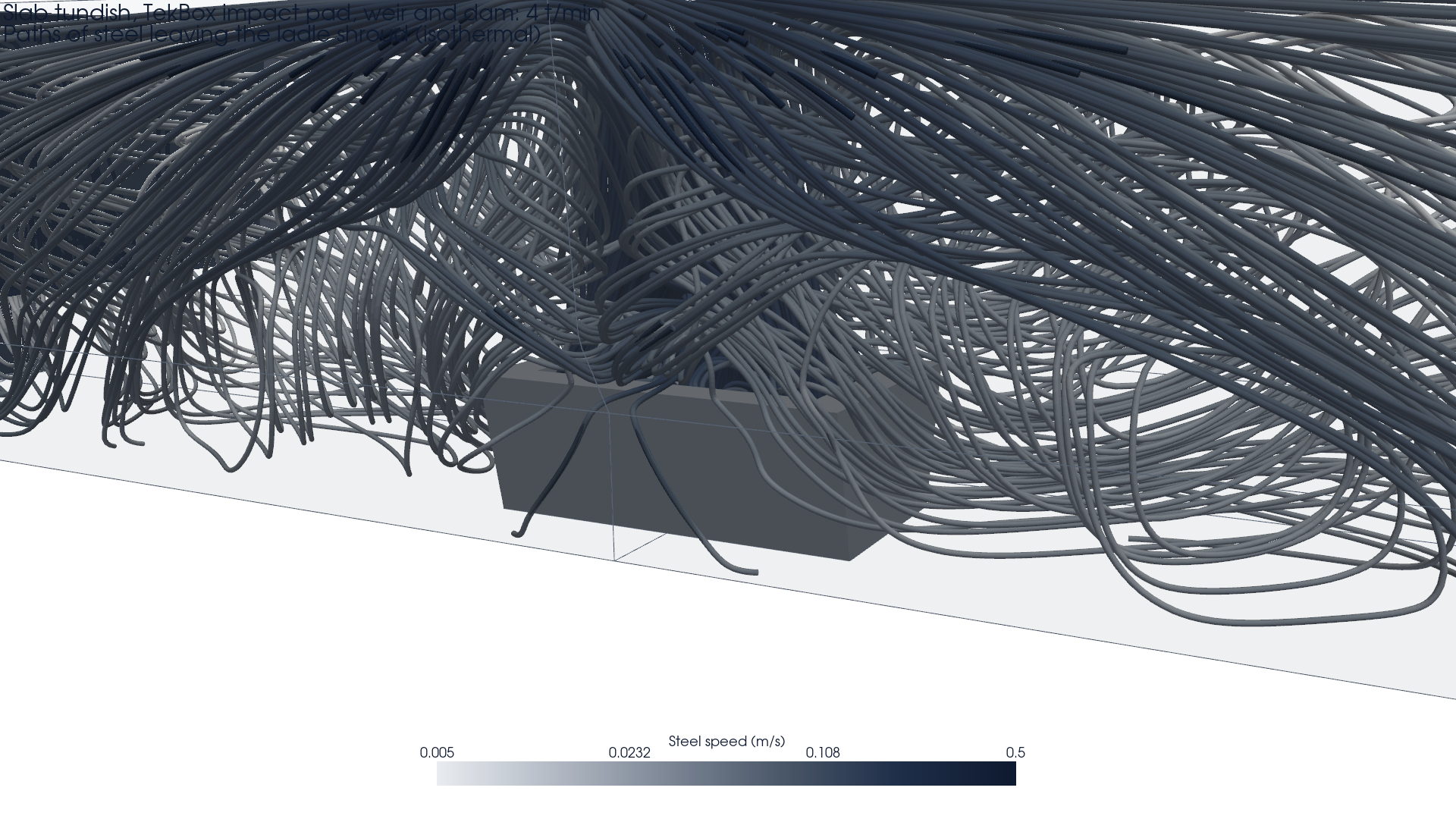
Near the end of teeming: when a vortex over the ladle well begins to drag slag into the tundish, and the tonnes still in the ladle when it does.The whole tundish, in one picture.
Hundreds of paths traced from the ladle shroud: bright where the steel is fast, dark where it lingers. The shape of the flow tells you at a glance whether your weir and dam are doing their job.
The questions we answer with it.
Ladle changes and start-up.
Casting is not always steady. TundRA Flow also models the moments that cause most of the trouble: a ladle change, with the level dropping and the slag cover opening, and the first ladle into an empty tundish, with the splash on the TekBox and the surface as the strands open.
Furniture options are run side by side under the same conditions, so a new weir height or dam position is a fair comparison, not a guess.
How a study runs.
- 01Your tundish, from your drawingsWe build the tundish and its furniture from your drawings. An engineer checks the model against them before anything runs.
- 02Your casting conditionsThroughput or slab size and speed, steel level, shroud and immersion, steel temperature: the conditions you actually cast at.
- 03Run in houseA fine mesh, finest where the stream lands, solved on our own machines, not a shared cloud. Your drawings and results stay with us.
- 04Report and results onlineA full PDF report, with a QR code to a private page holding the video, every picture and the report, behind an access code.
- 05Compare, then decideOptions compared like for like, so the furniture we propose is the one the numbers support.
Built to pick the better design
TundRA Flow™ models your tundish in full 3D computational fluid dynamics with tracer-pulse analysis, the established method for tundish flow studies. It is built and run in house by RLR.
Every option is run on the same tundish under the same casting conditions, so any difference in the results comes from the design alone. You get a clear, like-for-like ranking of your options before anything is built or installed.
We are now checking the model against published water-model measurements, to extend it from design ranking to absolute prediction.
Let's model your tundish.
Send us a drawing and your casting conditions, and we will show you how your steel moves.
or call +44 1902 880123